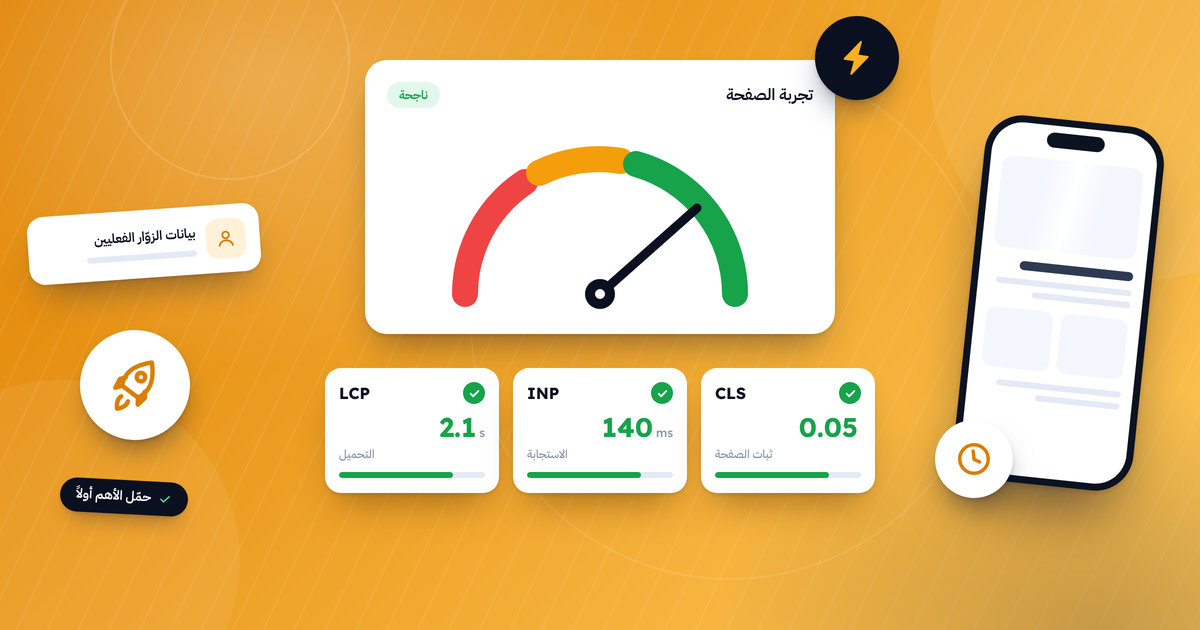
Google measures the visitor experience on your website with three metrics it calls Core Web Vitals. Each one answers a question the visitor asks without saying it out loud.
The three metrics
| Metric | Measures | Good threshold |
|---|---|---|
| LCP | When the largest element on the screen appears | 2.5 seconds or less |
| INP | How quickly the page responds to clicks and taps | 200 milliseconds or less |
| CLS | How much elements move around while loading | 0.1 or less |
A page passes when all three metrics meet the good threshold for at least 75% of its real visits. Why 75% and not the average? Because the average hides the visitors who struggle: those with weaker phones and slower networks.
LCP: has the page opened?
The largest element is usually the hero image or the main heading. Why it’s slow:
- A heavy hero image, or one larger than it needs to be.
- A server that is slow to respond.
- Stylesheets and fonts that block rendering.
The fix: compress the hero image and use a modern format such as WebP, load it with high priority, and enable caching.
INP: does the page respond?
It measures the time between the visitor’s click and the first change they see. This metric replaced the old FID metric in March 2024. Why it’s weak:
- Lots of scripts running at once.
- Accumulated plugins and tracking tools.
- Heavy menus and sliders.
The fix: remove the plugins you don’t use, and defer loading non-essential scripts.
CLS: does the page stay in place?
The visitor is about to tap a button, the content jumps, and they tap something else. The causes:
- Images without set dimensions.
- Ads or banners injected above the content.
- Fonts that swap after loading.
The fix: set the width and height of every image, and reserve space for elements that appear later.
Two supporting metrics
They aren’t among the core metrics, but they help diagnose the cause:
- TTFB: the time until the server’s first response arrives. If it’s long, everything after it is delayed.
- FCP: when the first content appears on screen.
How do I measure my website?
- PageSpeed Insights: enter the page URL and it shows real-visitor data if available, with suggestions.
- Google Search Console: the “Core Web Vitals” report classifies all your pages.
- Browser developer tools: for diagnosis while making changes.
Note the difference between lab data and field data. The first is a single test on a simulated device; the second is what your visitors actually experienced — and that’s what Google uses.
What slows stores down in particular?
- A wide image slider on the home page with several full-size images.
- Pop-ups and offer banners injected after loading.
- Chat, tracking and ad tools, each with its own script.
- Product photos uploaded straight from the camera.
Does speed improve ranking?
It’s one factor among many, and its effect on ranking is limited compared with the quality of the content and how well it matches what the visitor is looking for. But its effect on sales is direct: a visitor who waits leaves before seeing your offer.
Order of priorities
- Hero and product images: the biggest effect for the least effort.
- Plugins and tracking tools: remove what isn’t needed.
- Hosting: if the server response time is high, nothing after it will help.
- Fonts: load only the weights you use.
When will I see the effect?
Lab data changes as soon as you make the change. Field data is collected over 28 days, so wait about a month before judging the result in Search Console.
Quick questions
Do I need a score of 100 in PageSpeed?
No. The score comes from a single lab test. What matters is that the three metrics pass in real-visitor data.
My website is new and has no field data?
It appears once enough visits have been collected. Until then, rely on lab data.
Will more expensive hosting solve the problem?
It solves the server response time only. A heavy image stays heavy on any hosting.
We measure speed on every website before handover. For an existing website: Search Engine Ranking Optimisation (SEO) covers speed and structure with a before-and-after report. And the basics are in the article Search Engine Optimisation: Where Do You Really Start?.
Need what you just read put into practice?
Our prices are published: packages for every project size, and stand-alone services you can order on their own.